Mornings always begin at 6:30 for most of us working with
Operation Africa Partnership Station. We wake up get dressed, apply sunscreen, spray insect repellant all over us and head to breakfast were we are met with eggs and a warm cup of coffee. Having breakfast in al fresco in the wee mornings in Africa is really quite spectacular. I really hope before the trip is over I can start waking up early enough to enjoy the dewy mornings just before the sun rises because I love mornings such as those.

This morning we caravanned to the Manheam. On the way there some of the medical volunteers got into a discussion about the myths surrounding breast feeding in different countries. Christella, whose parents are native Filipino, mentioned she had recently been to the Philippines on a mission with other Filipino American health care professionals. What was so interesting was the myth behind why women in the Philippines don’t breast feed, they think their milk gets to hot and spoils because they work out in the heat all day long and they can’t feed their children spoiled milk. Obviously breast milk comes in a temperature controlled container so this is not true but still women believe it. She also mentioned that a friend of hers had volunteered in Kenya recently to teach women how to purify water for cooking and drinking. Although this seems like a pretty simple process it was apparently very hard to teach the women in Kenya. They would boil water and use it for cooking or drinking but if there wasn’t enough they would add un-boiled water to the boiled water in order to have enough which would in turn defeat the purpose of boiling the original pot of water. It was hard for them to grasp that they could not add dirty water to clean water and still have consumable water. The longer I hang out with these
Project HOPE volunteers the more I learn about medicine and cultures around the world. It is truly inspiring how much they love learning and giving back to the world through their knowledge.

After we arrived at the clinic 5 local midwives joined Robin, Sue, and I in one of the vans and we headed off to the USS Swift while the nurse educators and those who would be helping the clinic by providing basic care stayed behind. Robin and Sue are the nurse midwife volunteers who will be providing training throughout the mission to local midwives in Ghana and Liberia. They were set to teach a class of 34 midwives today, tomorrow and Thursday in a make shift class room aboard the U.S. Navy ship the Swift.
The Swift is not just a military boat it looks like a giant speed boat and is very impressive. You can tell it was built for speed. It isn’t as large as some of the other military ships but still huge and a boat man’s dream. The main eating and sitting space on the boat has built in theater chairs that are super comfortable and in between the two sections of seats is a dinning space. This entire spaced is surrounded by windows that provide a panoramic view of the ocean ahead of it and also television sets for movie nights.
I was awed when I saw the Swift as we drove up to where it was docked. It’s made from aluminum and is almost a charcoal color and has lots of angles. We got out of the car and walked up ramp leading to the hull of the ship where we found our make shift class room. It was a building that looked like our barracks—like a storage unit—in the middle of the hull. It fit all 38 of us comfortably and had windows and ac units. This classroom even had a projector screen. It was as if someone took a forklift, picked up a building from shore and dropped it off in the hull where it was strapped in to keep it from shifting as the ship moves.
When we opened the door to the classroom we were greeted with a loud welcome from the midwives, it was quite a site most of them in their white uniforms and white shoes. One of the Navy officers would later comment to me that it’s funny how the white uniform and white shoes is the universal nurse uniform and that nurses always provide a comforting feeling. These nurse midwives were very eager to learn and get started.
After a formal introduction Robin began teaching the basics of midwifery. She began with a lesson on normal and abnormal labor, followed by a lesson on using the Partograph. A Partograph is a special chart used by midwives so they can track a woman’s labor progress and plan ahead or prevent serious complications. Never having children myself a lot of this information was new to me and I tried to pay attention while I was taking pictures and swaying from the rocking boat.
After Robins lecture she had the midwives do a couple case studies using the Partograph. The seemed to really enjoy working in groups so much that we had to remind them it was lunch time.
The Navy provided us with lunch aboard the Swift.
Lunch was followed by Sue’s lesson on Hypertensive Disorder. Sue and Robin were both surprised with how much these women knew about delivering babies because in their experience with other missions in which they taught women “how to catch babies”, as Robin says, the midwives were so far behind. However, in Ghana the basics lesson was just a review for the midwives. They are all so knowledgeable. In fact because they knew their stuff we ended early enough to ask them about the way they deliver babies to see if it was any different from the U.S. Interestingly enough:
· Only 2 of the 34 women in the class delivered babies in a hospital.
· The midwives not only deliver the babies but also handle the prenatal and post natal care of the women they care for.
· The Ghanaian Government pays their salary and also licenses them.
· They have to renew their license every three years and a renewal requires them to take continuing education.
· C-sections are done in the hospital and are also elective.
· They don’t use epidurals.
· After a c-section a woman remains in the hospital 6 days and after vaginal birth they remain for 7-12 days.
· Annual Ob-gyn visits and regular exams are not common but they do use different types of birth control—such as Norplant, Depo, birth control pills while breast feeding and also condoms.
After the questions a couple of the Navy folks were kind enough to take us on a tour of the Swift, for some midwives this was their first time on a ship so they really enjoyed it. When the tour ended we took them out to the dock to show them the gift-in-kind (GIK)—GIK is donations made in actual products like medical supplies, equipment and medicines—they would be receiving at the Manheam Clinic. The donation comes from
Project HOPE and its partners and totals over $1 million dollars.
We ended up spending an hour and a half longer with the midwives because their bus arrived late. They are staying in a hostel because some came from as far as three hours away to attend these classes. They were very patient and we bonded with them. We talked to them about the U.S., our families, Robin showed everyone the family photo album she had in her bag, and someone invited Sue over to have goat since she has never had goat. When we left Sue also mentioned we were invited to visit a clinic in a town two hours away which we may have an opportunity to see. We will actually be off on Thursday because it is the Ghanaian Independence Day and also because the midwives are ahead of schedule which means we will finish the classes tomorrow.
It was a long day today; we barely made it back in time for dinner. The good news is we stopped by the airport to check on Sue’s luggage and it appears to be arriving tomorrow. Better late than never! When we arrived we were told the three working in the clinic on basic care had a great day. Cramped in a small room and with the help of a translator in some cases they were able to see 91 patients today. The nurse educators also had a successful day of teaching even though their projector burned out. They just improvised.

--Marisol Euceda

 Carine Richard, a certified nurse midwife of St. Joseph Hospital in Reading, PA, is every bit a Haitian: confident, emotive and tell-it-like-it-is. The Haitian-American Project HOPE volunteer grew up in the Petionville neighborhood of Port au Prince, Haiti, leaving with her family when she was 12-years-old to move to New York city. But her assertive and sunny bedside manner has made her a favorite for those she works with at the outlying clinics run by the Hospital Albert Schweitzer in Deschapelles, Haiti.
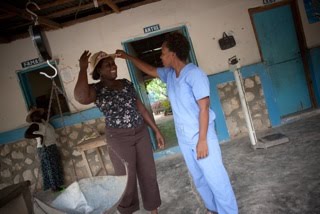 She describes teaching some of the clinic staff how to use a basic delivery date diagnostic chart, which many had never seen. “A woman walked into the clinic—32 weeks pregnant—and told the staff that she was two months pregnant, and the staff proceeded as if this was the case,” says Richard. ‘If you haven’t learned to calculate a delivery date in school, how can you accurately predict the correct birth date? If we really want to decrease the rate of mortality and morbidity we need to teach these people.”
 Story and photos by photojournalist and HOPE volunteer, Allison Shelley.


 Posts


