Showing posts with label Bonnie Hudlet. Show all posts

Tuesday, November 30, 2010

"Another Haiti is Possible"

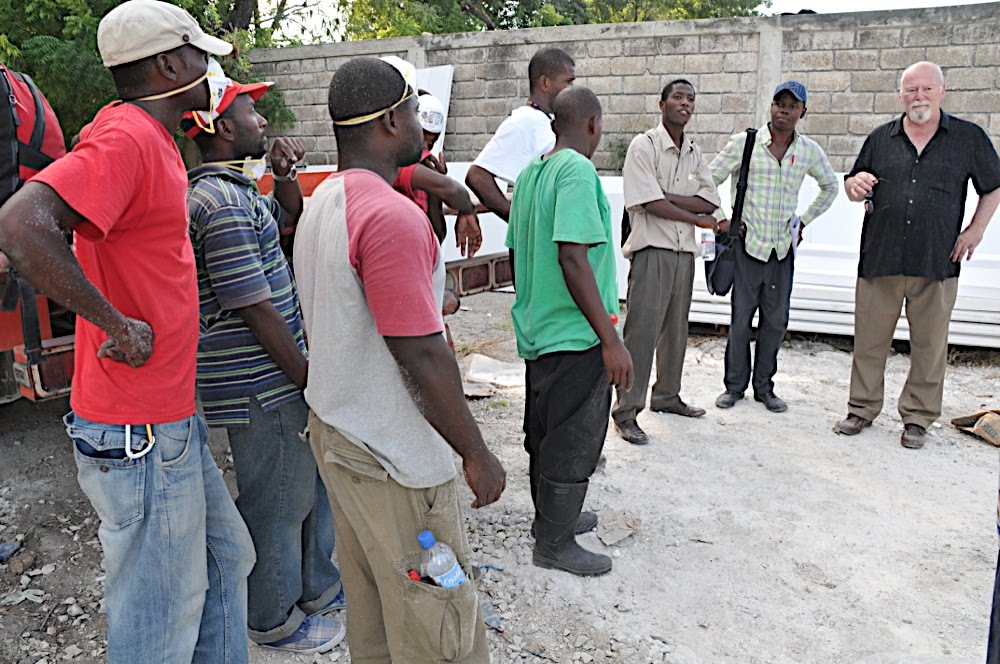
Today the Project HOPE and The Humanitarian Network team began putting together the dorm building that will house volunteers who come to Haiti to help with HOPE’s physical rehabilitation program. The building is going up next to a small tent “town.”

I had the opportunity to speak to Joseph Charles, 21, a Haitian who has been working on the building site as an interpreter and site manager. I asked Joseph what it has meant to him to work on this project.

“I can't wait to get up in the morning to get to the site,” he told me. “Sometimes I wake up at midnight and look at the clock wishing it was time to start working.”

Working on the building team is helping him see a path to Haiti’s recovery. “I realize that you [Mike, Ron, Bonnie] really, really care about what you are doing. Most NGOs just come and spend money, but not work on projects,” he says. “Maybe you are all sons of God. You are all blessed and you do things differently. I keep thinking about [how you make] every detail very important. It is very rare to find people like this and I will do my best to be part of the team.”

You see, Joseph wants to make a difference in his native land. “I want to help as much as possible to make a new Haiti,” he says. With a lot of hard work, and a little help from others, Joseph is confident, “another Haiti is possible.”

Story and photos by Bonnie Hudlet, HOPE photographer.


Monday, November 22, 2010

Cholera Team Saves Lives, Rehab Facility Progresses and Critically Needed Medicines Delivered

Cholera Team Saves Lives

The ICDDR,B team in Les Cayes spent morning at the Immaculate Conception of Les Cayes Hospital. The team trained 37 nurses and two physicians, a standing room only event.

The team later toured the hospital's cholera ward and resuscitated two patients in stage three of severe dehydration (no pulse, shallow respiration, and sunken eyes … no response to external stimuli.) They were within an hour of death. With consent of local staff, our team inserted an IV into the patient's collapsed veins and started a 3-liter bottle of Ringers lactate. Within minutes the patient revived and became responsive. In four hours, the patient was smiling and talking. Later a nonresponsive 3 year old was brought to the ward. Two IV attempts were unsuccessful because of severe dehydration; the third attempt was successful and within one hour, the patient was sitting up drinking Oral Rehydration Salts and laughing.

We spent the remaining portion of day caring for patients and engaging in bedside hands-on training with local nurses. There's a lot to teach and the Haitians are eager to learn.

The team is deploying to Cap Haitien on Sunday November 21 to continue training.

Story and photos by Fred Gerber, Project HOPE's Special Projects Director.

Rehab Facility Progresses

Shortly after the January earthquake, Project HOPE sent a team of experts from Mass General Hospital to evaluate how to best contribute to rebuilding health capacity in Haiti. They advised us to focus on rehabilitation needs for survivors near the quake’s epicenter. Since then, HOPE has been working to build a comprehensive Rehabilitation Center at the Adventist Hospital (HAH), together with partners Christian Blind Mission and Prosthetika.

Rehab activities have been going on for months without a dedicated space to offer services. HOPE now has a team of U.S. volunteers assembling three modular buildings at HAH – including a 24 x 40 ft Rehab Center, housing for international medical volunteers and housing for patients being fitted for prosthetic limbs.

In coordination with our partner, Humanitarian Network (HN) , the construction team is hiring local Haitians, teaching them how to assemble the structures. All local trainees will receive training certificates, providing short term income and, hopefully, longer term employment opportunities as rebuilding efforts grow.

From the first day containers of building materials arrived at the Hospital, area residents have come forth to help. A local French teacher is now serving as translator for the crew, as well as site administrator. Another man, at the hospital with his wife – an amputee receiving therapy – joined the construction crew. As HN leader Ron White reports, “we showed up and so did they – we share the same mission.”

Story by Courtney Guthreau, Project HOPE’s Director – Americas Region.
Photos by Bonnie Hudlet.


HOPE Delivers Critically Needed Medicines

It was quite a day. Project HOPE staff Doug Lane, Regional Logistics Manager and Charles Prospere, HOPE’s Haiti Representative, were able to obtain critically needed medicines and supplies from a local medical warehouse and get them delivered to Hôpital Albert Schweitzer where Project HOPE volunteers continue to care for Cholera patients. Check out the photos.


Photos by Bonnie Hudlet.


Thursday, October 14, 2010

Volunteers Help Treat 6,790 Patients in Panama

Project HOPE volunteers helped complete the sixth leg of the eight-county Continuing Promise 2010 mission. In Panama, volunteers along with their military counterparts helped:

Treat 6,790 patients
Performed 139 surgeries
Provided 7,445 health education contacts

Enjoy some more photos of volunteers at work in Panama


Wednesday, October 13, 2010

Learning From Each Other

Dr. Victoria McEvoy, a pediatrician from Cambridge, Massachusetts, is serving on her first volunteer mission with Project HOPE.

Working on the one-month long mission in Nicaragua and Panama did have its rough and tough moments. The weather was excruciatingly hot or soaking wet with rain. Time and resources did not permit everyone that needed care to receive it. Still, it was always a pleasure to watch Dr. McEvoy smile at a new patient and to see the joy on her face, along with the seriousness in her eyes when she was caring for each person.

A few patients really stand out in her mind. There was the 11-year-old boy with a hernia. "He had it all is life, " Dr. McEvoy says. "We were able to get him on the ship to have it removed."

She also treated a baby with pneumonia. "The mother brought he baby to the clinic and we were able to get the child admitted tot he local hospital," she says. "If the mom had not brought the baby to the clinic, she probably would have not have sought out the help the baby really needed."

Not only did Dr. McEvoy get to share her more than 30 years of pediatric experience with her patients, she also learned from them as well. “The thing that struck me is that the people we cared for have a lot of assets that we don’t have such as community, joy in simple things, and a hard working attitude,” She says. “It is amazing how much humans can endure, including the ones serving in this mission. They adapt to do whatever hand they have been given.”

Photos and story by Bonnie Hudlet, HOPE's Volunteer Public Affairs Officer

Tuesday, October 12, 2010

Giving Care Around the World

We all have different experiences even at the same place and at the same time,” says Dr. Mary Burry when speaking about participating in humanitarian missions around the world with her husband Dr. Tom Hoggard. The couple is now volunteering on their first mission with Project HOPE serving in Nicaragua and Panama as part of Continuing Promise 2010.

International patient care is not unique to Dr. Burry. A physician from Portland, Oregon, she has worked with disaster relief teams in Somalia, Albania, Turkey, Mozambique, Ethiopia, Afghanistan, Sri Lanka, Papua New Guinea, Honduras, Pakistan, Zimbabwe and Iraq. “What is unique about this mission is working with the military," she says. "This is the first time I have been a part of it. I have never lived on a ship.”

Mary, along with the other providers, have found that working with the military and people from so many different countries has been a great experience in seeing how things operate and the exchange of knowledge.

"I have a lot of respect for what the Marines and Navy personnel have to do below decks on this ship to keep this mission going," she says. “I am also impressed with Commodore Negus and how much he really believes in this mission. Arranging all this so that we can give care is amazing plus all the political stuff that goes into it . It has been an eye opener.”

As with all the international work Mary has done, the patients always make a personal impact on her life. Sunday she saw a young patient, about 4-years-old, with an immune skin disease that covered his entire body. He has been suffering with it for about a year now.

“The boy had squinting eyes because he was so uncomfortable. His skin looked like it had been scalded. It is very complicated and we were able to give him therapy for the first time. His condition is treatable with medications that that have here in Panama,” she says. Through an interpreter, Dr. Burry wrote out very complex instructions for the aunt who was taking care of the boy. "Now we can only hope that the aunt will follow through on the therapy."

With her one-month volunteer mission nearing its completion, Dr. Burry is contemplating re-adapting to home. "One of the hardest times for me was when I was in Somalia and starving people were before me everyday. One woman handed me her baby and said something. The interpreter said that four of her other children had died, and this is the only one living, and how was I going to help."

Dr. Burry returned to the States from that mission at Christmas time. "Walking around the hotel and seeing all that was there and a short distance away people were dying of starvation was very difficult," she says.

"The re-entry phenomenon is just difficult," she adds. "We go home and the garage door opens from the car, and we walk into the house and have nice long hot shower. We hop on a plane and are transported in a few hours to a different planet.”

Photos and story by Bonnie Hudlet, HOPE's Volunteer Public Affairs Officer

Friday, October 8, 2010

Giving Patients His Full Attention

Dr. Earl Wellington, a retired physician from Harlingen, Texas had been interested in volunteer medical work for years. He was also familiar with Project HOPE. This year, his intersections of interests came together when he accepted a volunteer position in internal medicine aboard the USS Iwo Jima and ashore in Nicaragua and Panama.

“I am enjoying the military interaction," says Dr. Wellington. "I retired from the Veterans Administration and I was in the military myself. Relating to the younger soldiers and their work in the Persian Gulf has helped me understand their military experience and unique circumstances.”

He is also enjoying learning from the military and other NGOS participating in Continuing Promise 2010. "I was not expecting to get the education from the military and NGOs that I have received. That was a nice surprise,” Dr. Wellington says. Referring to learning about tropical medicine and field medicine," Dr. Wellington adds. "It is kind of rough medicine that is practiced in many of these situations."

Dr. Wellington is also busy giving lots of time and attention to the patients he treats. "I am surprised at the number of people who don’t have basic medical care. They have to walk long distances to receive it," he says. "I am gaining a real appreciation for what these people have to live with. The best thing I can do while here is give the people that come to me my full attention and concern."

“I would like to do something like this again, and I would recommend it," he adds. "I guess the big thing for me is the time away from the family, and I would have to balance it with that.”

Dr. Wellington says he is sure his first volunteer experience with HOPE will stay with him when he returns home. “I think I will probably be more focused on the things I think are important and not waste so much time on things I don’t care about." With a bit of a chuckle he adds, "Maybe I won’t be so lazy…now and I will get after some of those projects I need to complete when I get home.”


I hope his wife is reading this.

Photos and story by Bonnie Hudlet, HOPE's Volunteer Public Affairs Officer


Thursday, October 7, 2010

"Honored to Help"

Having a major in Spanish and an emphasis in culture has helped Project HOPE volunteer nurse Jill Blashka adapt to ship life and communicate and relate to the people she has cared for at the medical sites in Nicaragua and Panama. “Speaking the language is great, though it is not always perfect,” she says. “Here we hear a mixture of English and Spanish and the local language.”

A pediatric nurse from Children's National Medical Center in Washington, D.C., Jill is also enjoying the educational component of this mission.

“I am enjoying teaching and connecting with people, even it if it is just one person every day," she says. “I remember one lady I met on the first day in Nicaragua. I was doing some health education and talking to her about dental hygiene, hand washing, breast exams. The conversation sparked a concern for her and we then had an in depth conversation about a lump that she felt.”

With all the positive experiences she has had helping people, there are also patients she will not forget because she was not able to help. “It is hard, sometimes, because we have to understand that before we arrive in a country, people hear so many rumors that expectations are sometimes too high. They think we can provide a miracle…and sometimes it just can’t be.”

Jill's language skills and her specialties in pediatric hematology and oncology have not only benefited the patients she has cared for in Nicaragua and Panama, but have also come in handy on the USS Iwo Jima. One day in the ward on the ship, when a military patient had a severe bloody nose, Jill knew exactly how to provide care.

She has also witnessed the impact of civilian volunteers participating in the Continuing Promise mission. Project HOPE has rotated a new group of volunteers into the four-month long mission each month. Jill says the monthly rotations of new volunteers “brings relief and new life for the people on the ship who have been here since the beginning.”

A first-time volunteer for HOPE, Jill says she is ready for another mission. She would like to work with HOPE in Africa, and then Asia.

Her advice to other would-be volunteers is to be e prepared mentally for the challenges. “Expect short showers, little privacy and long days. Also expect an experience of a lifetime.”

In her very rare quiet moments, Jill seeks solace in the ship's anchor room. “It is a good place to go at night and allow for some time alone, allow the brain to empty, and realize that I am really here and it is an amazing experience and I am honored and blessed to be here.”

Photos and story by Bonnie Hudlet, HOPE's Volunteer Public Affairs Officer

Wednesday, October 6, 2010

Volunteers Help Patient Meet Her President

There was a lot of excitement on the ship today! The President of Panama, Ricardo Martinelli came aboard the USS Iwo Jima. He was accompanied by his Vice-President Juan Carlos Varela, as well as U.S. ambassador to Panama, Phyllis M. Powers and Panama's Minister of Health, Franklin Vergara.

When the president walked into the hospital ward, he was greeted by Project HOPE volunteer nurse Anne Borden. He shook her hand, and offered her his thanks.

The Distinguished Visitors or DV visits as the Navy calls them, were quite exciting for the Panamanian patients onboard the ship. It meant so much to them to meet their president.

One particular patient, who was onboard for a cataract surgery had trouble seeing the president as he passed through her ward. Anne told me the patient so wanted to see the president, but she would be able to see him a lot better the following day after her scheduled cataract surgery.

Hearing this story, I approached one of the guards who was escorting the DVs and asked him if there was any way we might be able to take this patient to meet the President. He said that he would check and took off down the hall to talk with the leaders. I went back to Anne and the patient to bring them at least to the door of the ward.

The guard came back and asked if we could walk down to the visitors, a short way down the hall. Anne and I walked with the woman, and the guard even offered her his arm, but she could not see his arm.

That sweet woman was so excited. She not only got the chance to shake the President’s and VP’s hands, but to really talk with them! She also met the surgeon who would be performing her surgery the next day.

This was the highlight of my day and made the long wait in the ward for the photo opportunity well worth it. Seeing the President was exciting, but being able to give the patient an experience she will never forget, an experience she will surely share with her family and friends, truly made me feel as though I was helping in some small way. I only hope someday this patient will be able to meet the president again and see him clearly.

Photos and story by Bonnie Hudlet, HOPE's Volunteer Public Affairs Officer

Tuesday, October 5, 2010

Teaching Chronic Disease in Central America

Patiently, Project HOPE volunteer nurse, Anne Borden, listens as an elderly lady with diabetes talks about her life. She then talks with her, giving her advice on how to better control her disease within her environment in rural Central America.

Anne will repeat this scene, over and over again, listening to and teaching each individual patient to ensure all their questions are answered and that they understand their chronic diseases. “It is very gratifying. There is a lot of individual counseling and teaching and people are very appreciative of anything you do. We get the opportunity to teach people the basic fundamentals of how to manage their chronic diseases that they are going to have all their lives,” Anne says.

So she continues, meeting with each patient, one-on-one, helping them understand hypertension, diabetes, the risk factor for stroke and the importance of following through on medications and more.

Anne first worked with Project HOPE when her employer, Massachusetts General Hospital, sent a team of volunteers to work with HOPE in Haiti following the devastating earthquake. She says that volunteering after the earthquake really made her understand how connected every one really is. Her second volunteer mission with HOPE in Nicaragua and Panama is cementing that belief.

"It is interesting that the people in these Central American countries have the same health concerns as we do in the United States," she says. "They have the same basic health problems, the same concerns, such as how they get their meds or how are you going to help them get their quality of life back."

One patient in particular that sticks out in her mind is an older Nicaraguan woman, probably about 92. She was very healthy, and had her blood pressure checked. She said that she represented all the Nicaraguans who couldn’t get out of their houses. "She was very graceful, very well spoken and sweet," Anne says.

In addition to working with patients, Anne is also serving as HOPE's Operations Officer and Chief Nursing Officer during this portion of the Continuing Promise 2010 eight-country mission. Her leadership role makes her appreciate even more the complexity and scale of this annual humanitarian assistance and health education mission. "The Navy really has the infrastructure to pull off such a large mission that helps so many people," she says. "It is [also] nice to work with the Navy people, and get the opportunity to work with all the diverse people on the boat. At lunch we had every branch of the military at the table, but the Coast Guard, plus a dentist from Canada. How often can you say that you participated in something on such a large scale and worked with people from Germany, Canada, Paraguay, and the Netherlands?”

But of course, the best part continues to be the grateful smiles and big, sometimes sweaty hugs from the people she cares for. "I would do another mission in a heartbeat. It is a way to help our neighbors," she says.

Photos and story by Bonnie Hudlet, HOPE's Volunteer Public Affairs Officer


Monday, October 4, 2010

Volunteers Work Through Sun and Rain

One of first days in Panama and Project HOPE volunteers got to expereince another lesson in the extremes of mother nature.


“Yo ho! Let it pour!” and it did! We had a beautiful hot sweaty day until it was time to get on the LCU to go to the ship, and it was a typical tropical downpour! It literally started to pour when we were loading on to the LCU to return to the ship, and it poured the whole time. Most people were only concerned about their electronics i.e. my camera and computer, because it was too much of a downpour to even think about staying dry! As the commander says, “It is a chance to show character!”

I just wanted to pass the soap and shampoo! We could have showered and laundered our clothes at the same time!

Photos and story by Bonnie Hudlet, HOPE's Volunteer Public Affairs Officer

Friday, October 1, 2010

Hurricane Readiness Part of Mission

In route to Panama via Honduras from Nicaragua. Huh? Go to the storm instead of away from it? Huh?

I found out that one of the reasons the annual Continuing Promise mission takes place this time of year is that the ship, crew and volunteers are expected to be on hurricane readiness and prepared to help if a storm should hit a nearby country.

We got a first-hand taste at what hurricane readiness is all about last week as we were preparing to sail to Panama for the next stop on the Continuing Promise 2010 eight-country mission.

When Tropical Storm Matthew pounded the west coast of Central America and dropped a significant amount of rain on the already drenched nations, the USS Iwo Jima turned around from its southward destination in Panama and set sail to the point of Honduras and Nicaragua to be in position if any of the countries should ask for help.

As we headed north, the seas were obviously a little rougher, but not as bad as we have heard they could get. The song “…a rockin and a rollin…” kept coming to mind. A few took the motion sickness pills, and some used the patch.

We headed north and waited it out for about a day before we got word that help would not be needed and again turned south to continue the health education and humanitarian assistance mission to Panama. We moved “full steam ahead” and are planning on being back on schedule by sending helicopters ahead with equipment and supplies to help get the medical sights ready to open as soon as we arrive.

When we start our work on shore, we will be using LCUs (Landing Craft Utilities) instead of helicopters to get on shore. There is no protection on those, so we will be exposed to whatever the weather conditions might be. Because we can use the LCUs, doctors and nurses will be able to spend longer days on shore.

So what did we do in route to a possible international assist, then to Panama? Anything we could. Some took another look at the ship and went to places they had not been, some read, some slept, doctors and nurses gave classes, and one meal the Project HOPE volunteers and military personnel worked in the kitchen. They had a lot of fun and learned a few new things.

Photos and story by Bonnie Hudlet, HOPE's Volunteer Public Affairs Officer


Thursday, September 30, 2010

More than 7,000 Patients Treated in Nicaragua

“All hands on deck!” It is time to clear the helos of their cargo. Continuing Promise 2010 is preparing to leave the land of Nicaragua. And while we may be leaving, we are satisfied with the work we accomplished in the country. All in all, Project HOPE volunteers and their military and partner counterparts:


Treated 7,006 patients
Provided medical 22,613 services
Performed 149 surgeries
Participated in 31,343 educational contacts


While preparing for our departure, our work continued. While only a few had the privilege of going ashore on the last day, but all who wanted could help with clearing the choppers of their cargo.

Everyone who came off the helicopters had something in their hand, if they did not have their own things, they had a bag of mail, a shovel, or whatever else they could carry. They also formed a chain from one helo to the hangar bay to deliver the mail and whatever else they could send to the right spot with a human chain. I counted at least 100 people in the chain for the mail.

The plan for now is to pull anchor and head south to Panama. Hard to believe it is time to leave Nicaragua already.


Photos and story by Bonnie Hudlet, HOPE's Volunteer Public Affairs Officer